Honouring Our Pain for the World through Grief, Connection and the Work That Reconnects by Joanna Macy.
We are living through a time of profound ecological change. Climate change, biodiversity loss, environmental destruction and social injustice can leave us feeling sad, angry, hopeless, scared, anxious and/or helpless.
Sometimes, some of us struggle to express these feelings. We may feel overwhelmed by the news and what we see on social media. We may grieve the loss of familiar landscapes or the destruction of trees. It’s natural to worry about so much loss and change. Some of us might feel anxious about the world we are leaving to future generations.
Yet we don't have to carry these feelings alone.
The Work That Reconnects, developed by environmental activist and Buddhist scholar Joanna Macy, offers a way to acknowledge our pain for the world, reconnect with the essence of life and the natural world, and find strength in our relationships with one another.
At its heart is a simple invitation: to make space for what we feel, without turning away from the reality of the world.
The Work That Reconnects: The Spiral
The Work That Reconnects is a group-based approach that helps us reconnect with ourselves, one another and the wider web of life. It follows a spiral with four stages:
1. Coming from gratitude: Recognising what we love and appreciate about our lives and the living world.
2. Honouring our pain for the world: Making space for our sadness, anger, fear and grief about what is happening to the world. It does not have to be only around ecological grief. It can be any pain and grief we feel.
3. Seeing with new eyes: Widening our perspective and recognising our connection to the Earth, other people and future generations.
4. Going forth: Finding ways to participate in creating a better and more sustainable world, together.
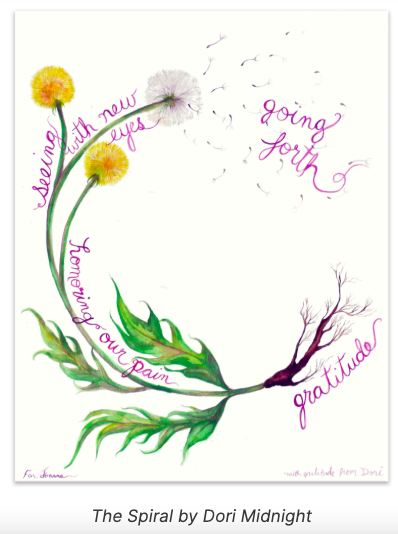
The spiral is not a linear process. We may move between the stages many times throughout our lives. Each stage supports the next, helping us remain connected to what matters, even when the world feels painful and uncertain.
Honouring Our Pain for the World
In our modern societies, we often learn to hide difficult emotions, especially when they concern something we cannot easily change.
We may tell ourselves to stay positive, focus on what we can control, or stop worrying about things happening far away. Sometimes, we can also avoid these feelings because they seem too painful to face.
However, honouring our pain for the world means allowing ourselves to acknowledge and express our emotional responses to the suffering of the Earth and its inhabitants.
This pain may take many forms:
Grief for the loss of forests, species and natural places.
Fear and anxiety about the future.
Anger about environmental destruction and injustice.
Sadness about the suffering of people, animals and ecosystems.
Helplessness or numbness when everything feels too much.
It’s an ancient and natural process of acknowledging, holding space for the pain and the suffering without the need to fix. Honouring our pain does not mean that we must find a solution to every problem. These feelings are not signs that something is wrong with us. They can reflect our love for the world and our awareness of what is at stake. Instead, it invites us to listen to what we feel, recognise that we are not alone, and create space for our emotions to be witnessed and shared. In other words, this approach is a compassionate and loving-kindness-based process where everyone can share and express what has to be expressed.
Creating Sacred Spaces for Our Pain Together
The Work That Reconnects offers different practices to help us express our feelings in a safe and supportive community. I will list below three (3) exercises that remind us that we do not have to face our grief alone.
1. The Truth Mandala
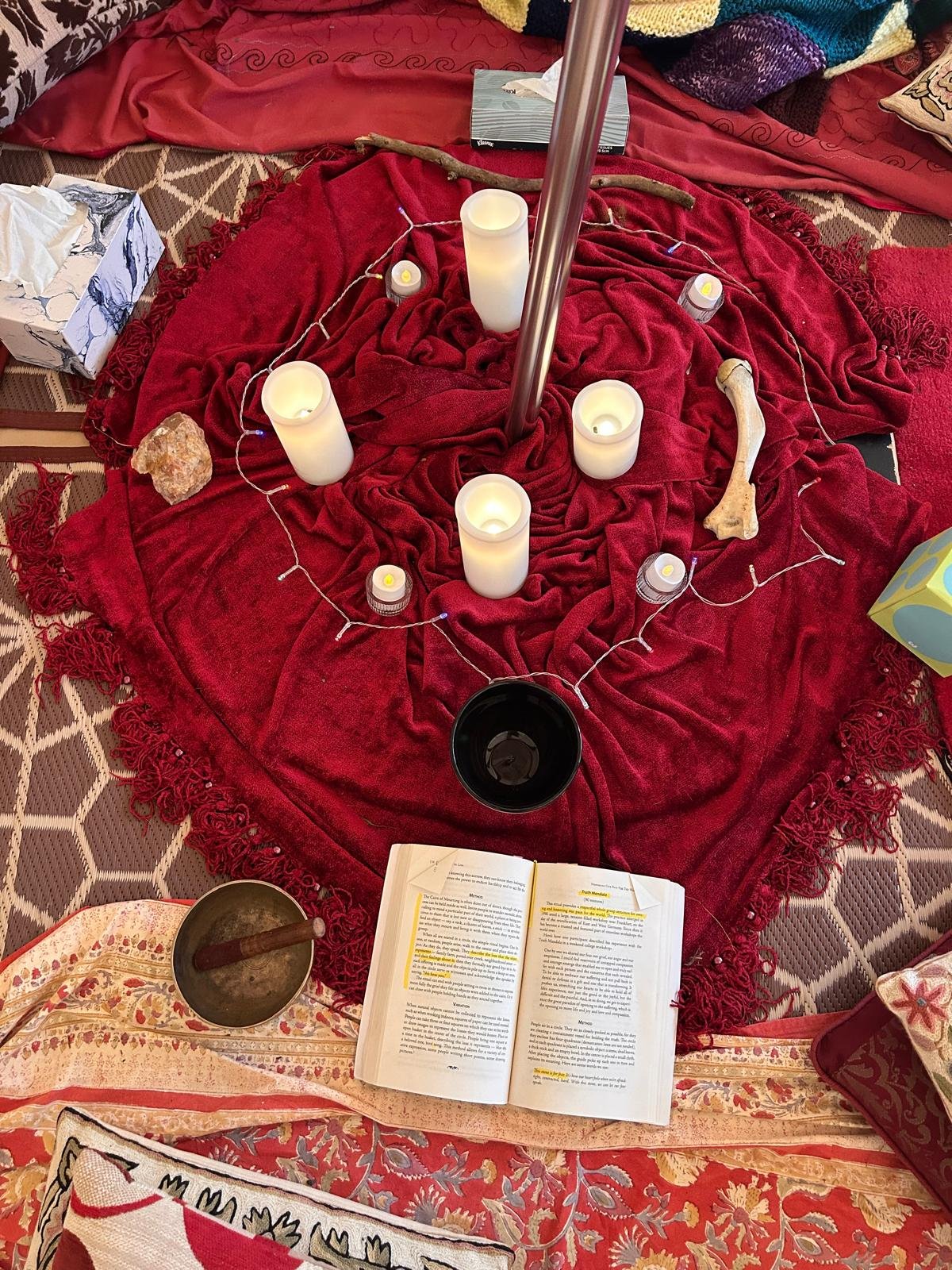
The Truth Mandala is a group ritual developed within the Work That Reconnects. It offers a space to acknowledge difficult emotions without judgement or the need to make them disappear. At the centre of the practice are four natural objects, each representing a different emotional experience:
A stone represents fear: What are we afraid of losing? What worries us about the future?
A stick represents anger: What makes us angry about the state of the world? What feels unjust?
A leaf represents sorrow and sadness: What do we grieve? What losses are we carrying?
An empty bowl represents emptiness: Where do we feel numb, exhausted or unable to respond? What feels too much for you right now?
Participants are invited to approach the mandala and choose an object that reflects what they are feeling. They can hold it, speak about their experience, or simply sit quietly with it. There is no need to explain everything or find the right words. Participants can share as much or as little as they wish. It does not have to be verbally expressed. Feelings and sounds (screams, rage, cries) may arise, and all is accepted and welcomed.
The group listens without interrupting, offering advice or trying to fix what is being expressed.
The purpose is not to remove these emotions, but to acknowledge them and recognise that others may be carrying similar feelings. We might respond to every share with a “thank you” or “I hear you.”
2. Ecological Grief Sharing Circle
Sometimes, the simplest practice is to sit together and speak honestly about what is weighing on our hearts. In a sharing circle, each person has the opportunity to speak while the others listen with care and respect.
As a facilitator, I might offer questions such as:
- What breaks your heart about the state of the world?
- What are you grieving or afraid of losing?
- What feelings do you find difficult to express?
- What do you wish others understood about your experience?
Participants are free to share their thoughts, emotions or personal experiences. Passing is always an option. The group does not need to agree on everything. The intention is to listen, make room for different experiences, and allow each person to feel heard.
We do not need to offer reassurance, compare experiences or tell someone that everything will be fine. Sometimes, simply being present with another person's pain is enough. We might respond to every share with “I hear you” or “I feel you.”
3. Sit Spot in Nature
Our pain for the world is not only expressed through words. We can also explore it through our relationship with nature.
In a group setting, participants might spend a few quiet moments outdoors, noticing the landscape around them. Participants could sit, finding a spot they feel connected to in nature. Everyone is invited to reflect through journalling, poetry, drawing or a simple conversation with that particular spot.
I might ask participants when we come back to the circle:
- What am I feeling as I observe the world around me?
- What do I wish I could say to the Earth?
- What do I need/want to acknowledge or grieve?
There is no expectation to feel peaceful or hopeful. The purpose is to allow whatever is present to emerge, while remaining connected to the natural world and the group.
You Do Not Have to Carry It Alone
Honouring our pain for the world is about recognising that our emotional responses deserve space, care and understanding. When we gather in community, something can shift. Our grief becomes something we can share rather than something we must hide or carry by ourselves. We discover that others are also worried, angry, heartbroken or scared. Grief work in ecopsychology is a reminder that in community, we can be heard. Our feelings are welcome, and we are not alone in this chaos.
I will leave you here with a beautiful quote from Joanna Macy: “The Work That Reconnects helps people discover and experience their innate connections with each other and the self-healing powers of the web of life, transforming despair and overwhelm into inspired, collaborative action.”
Live gently. Feel it all.
Sarah x
If you’re ready to slow down, reconnect with your natural self, and discover nature's healing benefits, I offer a free 20-minute phone call. If you feel called to explore how nature can improve your well-being, I invite you to visit my website or email me here.
Follow me on Facebook, Instagram, and LinkedIn
Read more from Sarah Frustié
Sarah Frustié, Ecotherapist, Forest Guide, Nature Retreat Facilitator, and Holistic Counsellor
Sarah Frustié is a bilingual nature-based counsellor and forest guide based in the Adelaide Hills. She supports people in caring professions to navigate burnout, release chronic stress and anxiety, and reconnect with themselves through nature-based practices, forest bathing, and guided nature and meditation retreats. With a deep belief in the healing power of the natural world, Sarah blends mindfulness, eco-psychology, trauma-informed, and whole-person approaches to create safe and sacred experiences. Founder of Sarah Frustié Therapy, every session is an invitation to slow down, breathe, and connect with the living world.
Resources:
Cunsolo, A., & Ellis, N. R. (2018). Ecological grief as a mental health response to climate
change-related loss. Nature Climate Change, 8, 275–281.
https://www.nature.com/articles/s41558-018-0092-2
Macy, J., & Brown, M. Y. (2014). Coming back to life: The updated guide to the Work That
Reconnects. New Society Publishers.
Macy, J., & Brown, M. Y. (2014). Coming back to life: The updated guide to the Work That
Reconnects. New Society Publishers. From chapter 7 of Coming Back to Life by
Joanna Macy and Molly Brown. Second edition. Published 2014.
https://workthatreconnects.org/resources/truth-mandala/
Macy, J., & Johnstone, C. (2022). Active hope: How to face the mess we’re in with
unexpected resilience and creative power (Rev. ed.). New World Library.
Pihkala, P. (2022). The process of eco-anxiety and ecological grief: A narrative review and a
new proposal. Sustainability, 14(24), Article 16628.
https://www.mdpi.com/2071-1050/14/24/16628
Work That Reconnects Network. (n.d.). What is the Work That Reconnects?
https://workthatreconnects.org/
Work That Reconnects Network. (n.d.). Honoring our pain for the world: Truth Mandala. This
resource includes a 25-minute training video featuring Joanna Macy and the Truth
Mandala Practice.